Network Layers
Exploring the access layer, transport layer, and core network architecture
Understanding Network Layers
5G networks are organized into distinct layers that work together to provide comprehensive connectivity services. This layered architecture enables modular design, flexible deployment, and efficient operation of the entire network. Each layer has specific responsibilities and interfaces with adjacent layers through standardized protocols.
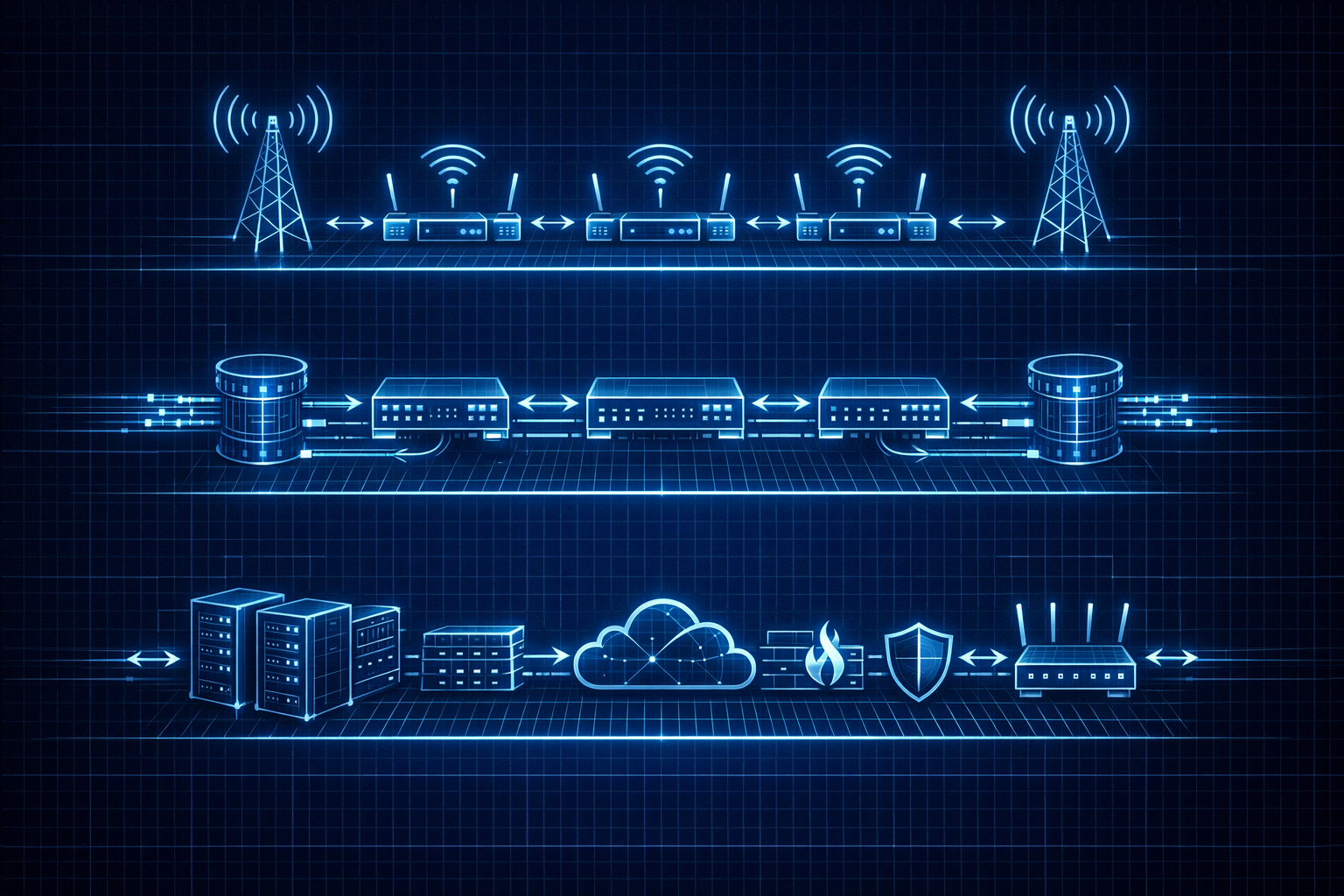
The three primary layers of 5G network architecture are the Access Layer, the Transport Layer, and the Core Network Layer. Understanding how these layers interact is essential for grasping the complete picture of 5G system architecture in Oman.
Access Layer (RAN)
The Access Layer, also known as the Radio Access Network (RAN), is the layer that provides direct wireless connectivity to user devices. This is the interface between mobile devices and the network infrastructure, handling all radio-related functions and managing wireless resources.
Radio Interface: The access layer manages the radio interface between user equipment and the network. This includes modulation, coding, and transmission of radio signals over the air interface. The radio interface operates in multiple frequency bands, including low-band for coverage, mid-band for balance of coverage and capacity, and high-band (mmWave) for maximum capacity in dense urban areas.
Beamforming: Advanced antenna systems use beamforming techniques to direct radio signals toward specific users rather than broadcasting uniformly. This increases spectral efficiency, improves signal quality, and reduces interference between users. Beamforming can be implemented using digital, analog, or hybrid approaches depending on deployment requirements.
Resource Scheduling: The access layer manages radio resources dynamically, allocating time and frequency resources to different users based on their needs and network conditions. This scheduling ensures efficient use of available spectrum and provides quality of service for different types of applications.
Mobility Management: When users move between coverage areas, the access layer manages handover procedures to maintain connectivity without interruption. This involves coordinating between multiple base stations and making decisions about which base station should serve each user at any given time.
Dual Connectivity: 5G supports dual connectivity, allowing user devices to connect to multiple base stations simultaneously. This improves reliability and enables seamless transition between different frequency bands and coverage areas, enhancing the overall user experience.
Transport Layer
The Transport Layer connects the Access Layer to the Core Network, providing high-capacity, low-latency links for data transport. This layer is critical for ensuring that the massive amounts of data generated by 5G applications can be transported efficiently between base stations and core network functions.
Fiber Optic Infrastructure: The transport layer primarily relies on fiber optic cables due to their high bandwidth capacity and low latency characteristics. In Oman, extensive fiber networks have been deployed to support 5G connectivity, providing the backbone for data transport between network elements.
Backhaul and Fronthaul: The transport layer handles both backhaul and fronthaul connections. Backhaul carries data between base stations and the core network, while fronthaul connects radio units to baseband processing units in split architecture deployments. These connections must meet strict latency and bandwidth requirements to support 5G performance targets.
Slice-Specific Transport: Network slicing in 5G requires the transport layer to support different service requirements for different slices. This means the transport infrastructure can provide varying levels of bandwidth, latency, and reliability depending on the needs of each network slice.
Segment Routing: Advanced routing techniques like segment routing enable efficient traffic engineering across the transport network. This allows network operators to optimize traffic flows, provide redundancy, and ensure that critical traffic receives the required treatment.
Synchronization: Precise timing synchronization is essential for 5G operation, particularly for time-sensitive applications and coordinated transmission between multiple base stations. The transport layer provides timing signals using protocols like IEEE 1588 Precision Time Protocol (PTP) to ensure all network elements are synchronized.
Core Network Layer (5GC)
The Core Network Layer represents the intelligence of the 5G system, handling authentication, mobility management, session establishment, and data routing. The 5G Core (5GC) adopts a service-based architecture that differs significantly from previous generations, offering greater flexibility and scalability.
Service-Based Architecture: Unlike previous core networks that used monolithic functional elements, the 5GC implements network functions as services that communicate through standardized interfaces. This modular approach enables easier deployment, scaling, and integration of new services. Each network function exposes service-based interfaces that other functions can consume.
User Plane and Control Plane Separation: The 5GC clearly separates user plane functions (which handle actual data traffic) from control plane functions (which manage signaling and control). This separation allows independent scaling of user and control plane resources and enables more flexible deployment architectures.
Stateless Design: Where possible, network functions in the 5GC are designed to be stateless, storing session state in separate data repositories. This improves scalability and resilience, as instances can be added or removed without losing session information.
Network Slicing Support: The core network provides comprehensive support for network slicing, allowing multiple logical networks to be created on top of shared physical infrastructure. Each slice can have its own characteristics and requirements, customized for specific use cases or customer needs.
Cloud-Native Implementation: The 5GC is designed for cloud-native deployment, utilizing containerization and orchestration technologies. This enables elastic scaling, faster service introduction, and more efficient resource utilization compared to traditional hardware-based deployments.
Service Exposure: The core network provides APIs that enable third-party applications to access network capabilities and information. This service exposure supports innovative applications that can leverage network features like location information, quality of service management, and network analytics.